
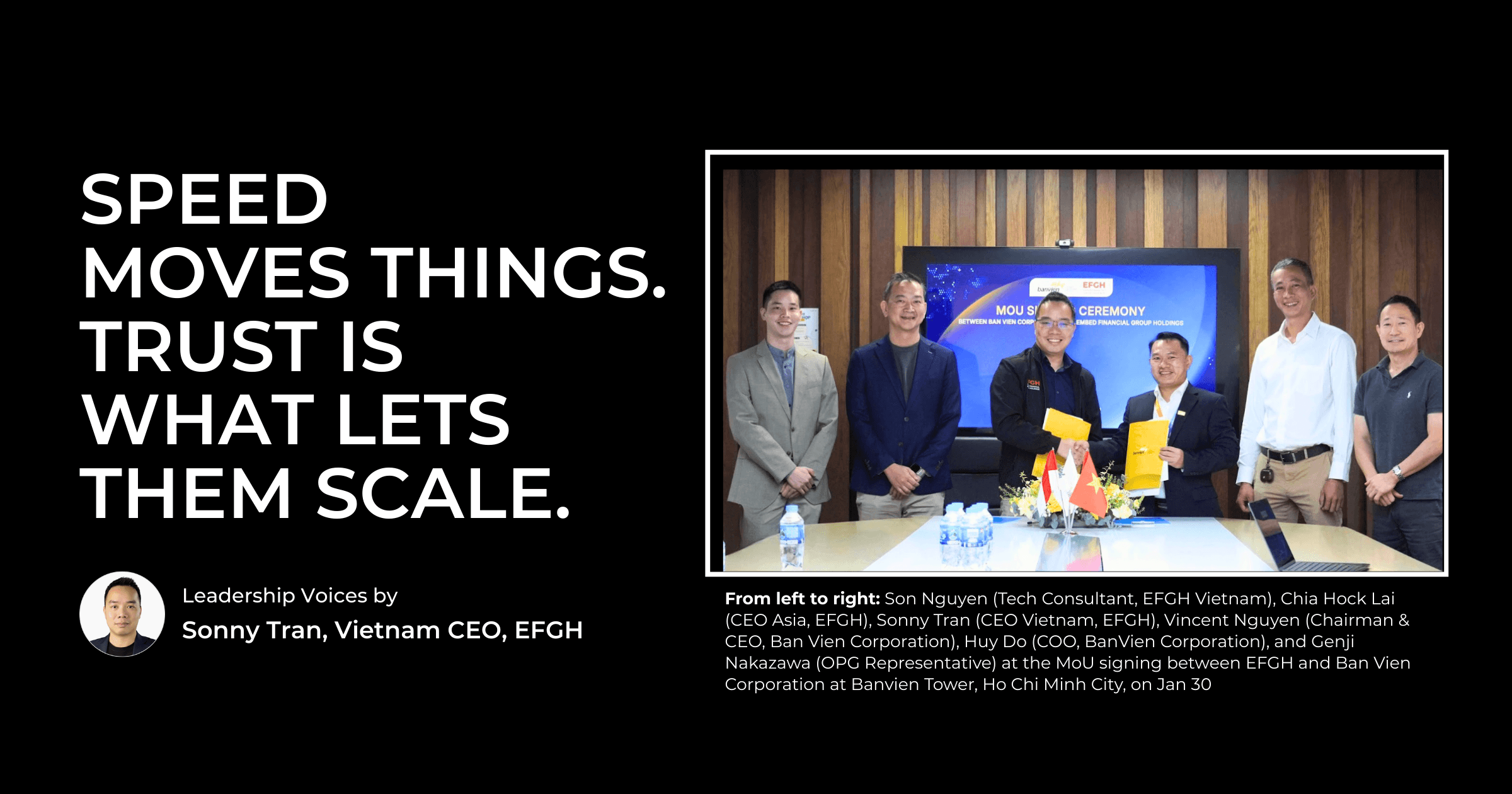

Last week (Jan 30), Embed Financial Group Holdings signed an MoU with Ban Vien Corporation to collaborate on advancing Vietnam’s high-tech and fintech ecosystem.
The focus is on building and deploying production-grade digital and financial infrastructure, combining global architecture with strong local engineering and regulatory execution. It reflects our intent to work together on systems that can scale responsibly across partners, markets, and use cases.
An MoU is not execution. Anyone who has built real systems knows that.
But it represents intent. And intent matters when it reveals how you think about scale, risk, and responsibility.
That’s why this moment is worth reflecting on.
The speed era
For years, our industry has worshiped speed. Move fast. Launch early. Disrupt incumbents. In the early days of fintech, that mindset worked. Speed helped teams bypass legacy systems and prove demand.
But that playbook is now hitting its limits.
After years building technology inside regulated financial institutions, I’ve learned a simple truth: speed gets you started, but trust is what lets you scale.
You can move fast in one market.
You can only scale across partners, regulators, and borders if trust is designed into the system.
Where it breaks
This is where many AI and fintech initiatives quietly stall.
Teams build impressive products quickly, then struggle to scale. The problem is rarely the algorithm. It’s usually the foundations: data governance, explainability, integration, and compliance. The unglamorous work that determines whether something survives contact with reality.
I’ve seen this firsthand.
A digital wallet with a polished interface failed because we underestimated the merchant acceptance network. The ecosystem mattered more than the app.
I’ve delayed launches that looked ready because the integration layer wasn’t stable enough for partners. I’ve also stopped AI initiatives that were technically accurate but impossible to explain clearly to regulators.
Speed created momentum. The lack of trust stopped scale.
AI reframed
That’s why I no longer think of AI as a product.
AI is infrastructure for trust.
If you can’t govern it, you can’t deploy it.
If you can’t explain it, you can’t scale it.
Why this MoU matters
This is how I see the MoU we just signed, not as a headline, but as a signal. Not speed for speed’s sake, but speed that survives scale.
At EFGH, we focus on building financial and digital infrastructure where trust is embedded at the architectural level.
Ban Vien brings deep engineering capability and local execution strength to turn that architecture into systems that actually work within Vietnam’s regulatory and market reality.
No disruption theater. Just durable scale.
Questions
If you’re leading technology or product today, here are a few practical questions to ask yourself:
- Would your AI roadmap survive an audit tomorrow?
- Are your PoCs built to reach production, or just to impress?
- Are you preparing your people for scale, or just your software?
The edge
The next phase of AI and fintech won’t be won by those who move fastest in isolation.
It will be won by those who can move fast locally, scale globally, and earn trust continuously.
Speed starts things. Trust is what makes them last.

Share