
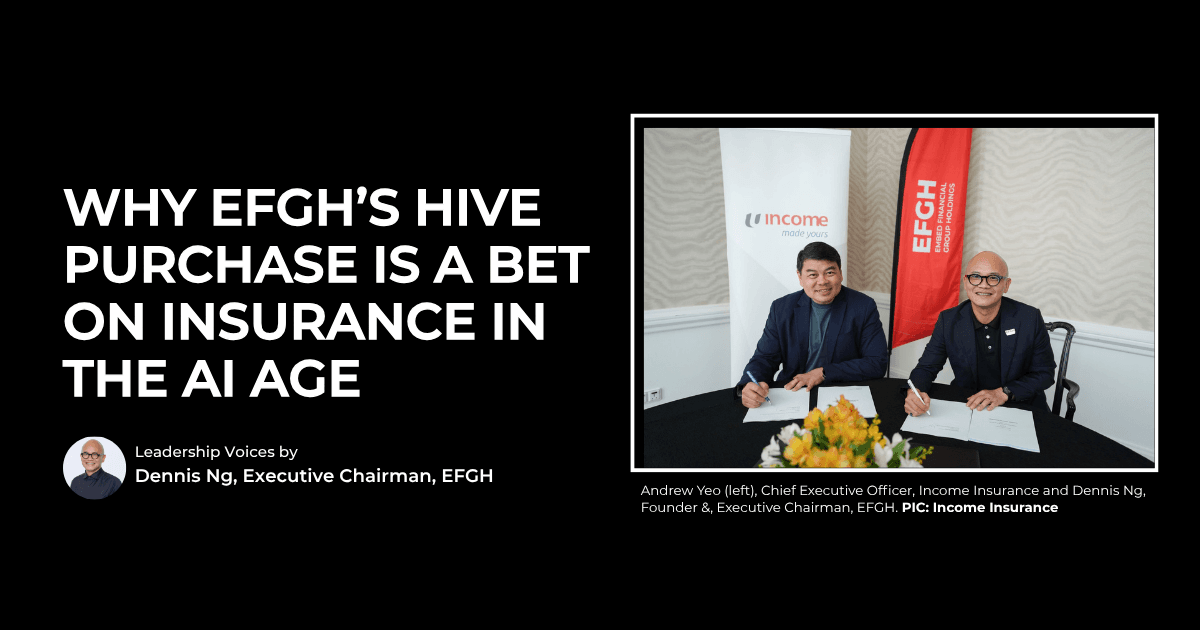

When EFGH acquired HIVE from Income Insurance, we were not buying a digital insurance platform. We were buying infrastructure for the AI age.
HIVE was built by Income over five years to help insurers create, distribute and manage insurance products. It supports flexible products that can be sold on a subscription, pay-per-use or bite-size basis. After the transaction, EFGH owns 100 per cent of HIVE. Income stays on as a customer.
That matters. Because the future of insurance will not be decided by who has the best policy. It will be decided by who can place the right protection, at the right moment, inside the digital platforms people already use.
The shift
For decades, insurance has been sold by people.
Financial advisers and agents build trust, explain products, collect information and help customers make important decisions. That model is not going away, especially for complex life, wealth and family protection needs.
But human distribution has limits.
An adviser can only meet so many customers in a day. He can only travel so far. He can only serve markets where the economics make sense. That is why large parts of Asia and Africa remain underinsured. The issue is not lack of need. It is a lack of reach.
The gap
The numbers of the under-insured are huge.
The World Bank has noted that insurance penetration in Sub-Saharan Africa, MENA (Middle East & North Africa) and South Asia remains below 2 per cent of GDP, against 9.3 per cent in North America and a worldwide average of 3.9 per cent. In East Africa, fewer than 10 in 100 people are estimated to have any formal insurance.
Asia faces a different but equally large opportunity. McKinsey estimates that gross written premiums for embedded insurance in Asia could reach US$270 billion in by 2030, and that closing Asia's life protection and savings gap could generate more than US$292 billion in additional annual premiums.
This is not a niche problem. It is a structural challenge waiting for a different distribution model.
The mobile phone
That model is already in people's hands.
Singapore's smartphone ownership among residents has reached 97 per cent. In Asia-Pacific, GSMA reported 1.5 billion mobile internet users in 2024, representing 52 per cent of the population. In Sub-Saharan Africa, there were 527 million mobile subscribers by end-2023, with mobile internet penetration at 27 per cent and a usage gap still sitting at 60 per cent.
That is the paradox. Insurance penetration is low. Mobile reach is rising fast. The opportunity sits in the nexus of these two trends.
The AI
AI changes the economics of that gap.
Much of insurance remains document-heavy, process-heavy and people-heavy. Underwriting, onboarding, servicing and claims still involve too much friction. That makes small policies hard to sell profitably through traditional channels.
McKinsey estimates that generative AI could produce US$50 billion to US$70 billion in insurance industry revenue, with the greatest impact in marketing and sales, customer operations and software engineering. Accenture has highlighted an AI-based claims system that delivered up to a 73 per cent improvement in claims-process cost efficiency.
That is not just automation. It is a change in unit economics.
A US$2 or US$5 micro-policy cannot carry the cost structure of a traditional insurance sale. But if discovery, onboarding, payment, policy issuance, servicing and claims can be digitised and supported by AI, protection can reach customers who were previously too expensive to serve.
The rails
This is where HIVE fits EFGH.
EFGH is not trying to become a traditional insurer. We are building financial infrastructure.
Through our partnership with SimplyGo, we are exploring embedded micro-insurance inside a platform already used for everyday mobility in Singapore, with EFGH infrastructure supporting real-time policy issuance, premium collection and insurance connectivity. Through our partnership with TS Group, we are deploying a digital wallet and remittance platform to serve more than 50,000 foreign workers in Singapore, with micro-insurance embedded in the offering.
Across Asia and Africa, similar logic applies to remittances, payments, device financing, public transport, agriculture, travel and SME markets.
Where there is a transaction, there is often a risk. Where there is a risk, there can be protection. Where protection can be embedded digitally, insurance can scale.
The moat
Many people assume AI itself will be the competitive advantage. I do not.
AI will become increasingly available. Models will improve. Costs will fall. Intelligence will become abundant.
The real advantage will sit elsewhere: trusted relationships, regulated pathways, payment rails, customer access, distribution partnerships, execution on the ground.
That is why HIVE is such a good fit for EFGH. We now have a proven digital insurance layer at precisely the moment when AI, smartphones and embedded finance are converging.
Why it matters
Insurance used to be sold across a table. Increasingly, it will be delivered through the phone in your hand.
That does not make financial advisers irrelevant. It makes the market larger. Human advice will remain essential for complex protection. Simple, contextual and recurring protection can increasingly be embedded into the platforms people already use every day.
For insurers, this opens new segments. For partners, it creates new revenue and loyalty. For customers, it makes protection simpler, cheaper and more relevant. And for EFGH, it strengthens the foundation we are building: trusted financial infrastructure for underserved markets in the AI age.
HIVE is more than a purchase. It is a platform for the future of protection.

Share